A: There potentially several sources that can contribute to water issues in fuel/tanks. Ethanol and bio-diesel blended fuels will inherently pull moisture from humid air. Partially filled fuel tanks will sweat with day to night temperature changes and older seals, gaskets and O-rings on fill caps often leak. They should be changed every 18-24 months. (See our “TECH-TIPS” page for helpful details)
Q: What do I do if I find water in my fuel filter?
A: If it is a small amount ½ to 1-ounce but the engine starts easily and is running smoothly simply change the filter(s) and keep a close watch to see if the water returns or gets worse. If it is 3-ounces or more or gets progressively worse you should call a professional tank cleaning/fuel polishing company. They will remove the water from the bottom of the tank, clean the tank and polish the fuel.
Q: If I have water in my fuel tank do I lose the fuel?
A: In most cases NO, an experienced, professional fuel polishing company can usually save 70-90% of fuels less than 2-years old. However, beware, many unscrupulous companies will simply drain your tank or polish the fuel and leave. They have no means or knowledge of how to clean behind the baffles for trapped solids and water so the problem may reoccur in a few months. An experienced, knowledgeable company will have access to safe chemicals capable of effectively cleaning the tank, dissolving solids, suspending and filtering/removing the water trapped behind tank baffles and rejuvenating the fuel to a usable state.
Q: What is the best way to maintain tanks in small boats and equipment?
A: Do not expose them to direct sunlight or extreme weather if possible, keep them 90% full and use a full spectrum fuel additive. This regimen will eliminate 70-80% of potential fuel problems in any fuel tank. (See our “TECH-TIPS” page for helpful details)
Q: Why do most car/truck owners seldom have fuel problems?
A: They use their fuel and refill their tanks every 1-3 weeks so they always have fresh fuel. They also only need a fuel additive/cleaner every 3-6 months to lubricate the fuel pump and clean the injectors. Dirty injectors can lead to 5-20% reduction in MPG. Fuels stored 90-days or longer represent 70-80% of tank/fuel problems. (See our “TECH-TIPS” page for helpful details)
Q: What is the storage life of regular gasoline?
A: Regular gasoline begins discernible deterioration after about 90-days and should be considered risky to use after about 6 to 9-months in moderate climates and even less in severe climates. However, routine tank maintenance and the use of a premium full spectrum fuel additive can extend the usable life to 1-2 years. (See our “TECH-TIPS” page for helpful details)
Q: What is the storage life of ethanol blended gasoline?
A: Ethanol blended gasolines (E-10, 15 & 20) can experience significant deterioration after about 60 days in moderate climates and if stored in wet or humid conditions even less. It can be risky to use after about 90-days. It requires a more diligent effort but again reducing moisture exposure, proper tank maintenance and the use of a premium full spectrum fuel additive can dramatically extend its usable life up to 1-2 years. (See our “TECH-TIPS” page for more ethanol details)
Q: What is the storage life of diesel (ULSD) fuel?
A: With regular tank maintenance Pure “Ultra-Low-Sulfur” diesel can typically be stored for 6 to12-months in moderate climates without significant deterioration. The use of a premium full spectrum fuel additive can extend usable to 2-3 years and even much longer with professional fuel management programs that include fuel testing and polishing. (See our fuel management page for details)
Q: What is the storage life of diesel/Bio-diesel blends?
A: Most diesel fuels sold in the U.S. today are blends with 5-20% bio-diesel. Those fuels are much less stable than pure unblended diesel. They typically experience notable degradation after 3-6-months. Regularly scheduled tank maintenance and use of a premium full spectrum fuel additive can extend usable life to 1-2 years and much longer with professional fuel management programs that include fuel testing and polishing. (See our fuel management page for details)
Q: How do I find a good fuel polishing company?
A: Check with your local dock master, fuel supplier, engine mechanic or search the internet. However, be extremely careful, use companies with personnel and equipment that are neat and clean, that’s a direct reflection of the quality of work they perform. Ask for references, experience level and proof of insurance. Find out if their equipment is mobile for use in limit access areas and if they provide before and after fuel samples as proof of performance. BEWARE, and choose your vendor wisely, fuel polishing is an extreme explosion hazard, very dangerous and most states do not require or provide any training or special licenses to be in the business.
These questions and answers are based on more than 40-years of fuel experience. We have cleaned thousands of fuel tanks and polished and rejuvenated fuels with a 99% + success rate.
There are hundreds of fuel additives on the national market, so how do you know which one works best and are not harmful in short term or long term use?
First, you should know a few facts and the history of fuel additives. A fuel additive is a blend of chemicals used to modify the makeup and/or improve the usability of gasoline or diesel. What most people don’t know is all fuels are a blend of chemicals and not simply one component. Therefore all fuels contain an additive package before they even reach the pump.
I am a retired “Blown-Fuel” drag boat racer/engine builder and I have blended and used fuel additives for more than 40-years. We produced additives to mix with gasoline and diesel that boosted a 454 CID gas engine from 450HP to 1200HP. Racers today are using advanced fuel additive blends to make 10,000+ HP with a 500 CID engine. You can watch them at boat and car drag races on television almost every weekend. I chuckle as I often hear people say, “I don’t believe in fuel additives, they don’t work”. That is usually because they purchased the least expensive one they could find. Don’t try to tell that to us racers. The skeptics simply don’t understand how fuels are produced or modified and how to buy one that is effective.
Aftermarket fuel additives have been around since Henry Ford. The old model “T” ran a lot better when he used a fuel additive. Check it on the internet; you will see that I am correct. However, I do agree that most aftermarket fuel additives you purchase don’t work as claimed. If you check their “Safety-Data-Sheet” (SDS) you will see that most are made up of low quality, ineffective or marginally effective ingredients so they can be sold at a low cost. I am baffled by the fact that anyone would risk damaging an engine that cost tens of thousands of dollars to save a few pennies or dollars. Quality cost more money with anything you buy.
There are a few factors to consider before you buy a fuel additive;
You should not use a fuel additive that contains alcohol. Your engine manufacturer plainly states that using more than 10% (E-10) ethanol fuels will void your warranty. Well, if you buy regular pump gas with 10% ethanol and add an additive containing more alcohol you just voided your warranty. (The exception is Flex Fuel engines).
More than 70% of all engine failures are water/fuel related. You should look for an additive that states it helps control water. However most of those use alcohol. (even those usually are not very effective)
You want one that adds lubrication because our new reformulated fuels have less than the fuels of the past.
You should also look for one that stabilizes the fuel to help slow degradation in stored fuels. Modern fuels are not nearly as stable as fuels use to be.
A few of the premium additives also have combustion enhancers that help the fuel burn cleaner with less carbon/smoke. (Extremely important for four-stroke outboards)
You will usually have to buy two or three different brands/bottles of the less expensive additives to get all of these benefits and end up spending more money. The bottom line is look for a premium fuel additive that meets all the above criteria. Only a very few additives are effective in all categories, they will never be the lowest or medium priced additives on the shelf. Quality always costs little more but is less expensive in the end.
Most diesel fuel sold to the public today is actually a blend that contains up to 10-20% bio-diesel. Our government allows suppliers to blend up to 9% without even posting it on the pump or telling the consumer. Vendors make a few cents more per gallon by adding/blending bio-diesel with regular diesel.
However, there is a downside for the consumer; methanol/alcohol is usually included in the process of producing bio-diesel. Therefore the diesel you are purchasing most likely contains a small amount of alcohol which leads to problems similar to that of blended E10-E85 gasoline. Blended diesel accumulates more water in the tank, has a shorter storage life, less lubrication, gels faster in cold weather and promotes more microbial growth in tanks than non-blended diesel. Further, blended diesel usually gets less MPG than non-blended diesel.
If you have a large amount of stored diesel fuel in a boat, RV, generator or tank and you are not using a premium additive you are likely going to have a fuel stability problem beginning in as little as 90-days that will progress over time.
You should check your filters for solids and water at least every six months and replace all filters no less than annually. If you see black solids that look like coffee grinds, black or brownish/tan fluffy solids similar to snowflakes or tan and/or cream colored slime you have a serious problem in the tank. At that point you should call a professional tank cleaning/fuel polishing company for help. Those problems can lead to premature engine wear and sometimes serious engine damage.
For more information on how to prevent those problems see our products page. If you already have problems we can help, see our services section.
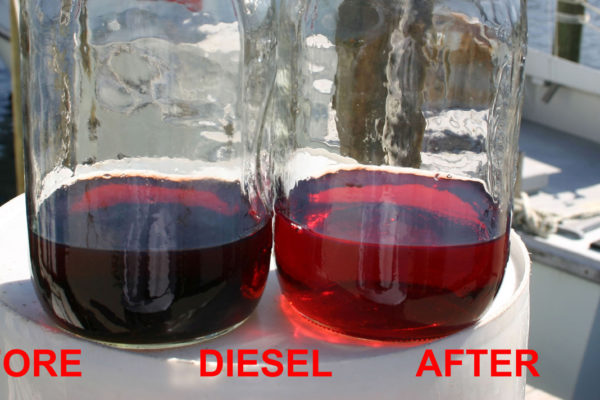 Most diesel fuel sold to the public today is actually a blend that contains up to 10-20% bio-diesel. Our government allows suppliers to blend up to 9% without even posting it on the pump or telling the consumer. Vendors make a few cents more per gallon by adding/blending bio-diesel with regular diesel.